
Pump Frame Cracking Root Cause Analysis
Summary
A Petrochemical company was experiencing cracking and excessive vibration on three reciprocating charge pumps: A, B, and C. The pumps showed cast iron upper frame cracking, elevated rocking motion, and, Pump B suffered a connecting rod failure that caused extensive damage.
Mechanical Solutions used experience, already available limited field test data, and Finite Element Analysis (FEA) methods (Figure 1) to perform a natural frequency evaluation, stress analysis, deflection examination supported by comparison to customer provided field test data to determine whether the failures were caused by normal operating loads, resonance, material change, or mounting conditions.
The investigation found that normal operating loads were not sufficient to cause cast iron frame cracking. Instead, the cracking was most consistent with pressure upset conditions, with an estimated pressure increase of approximately 30% above normal operation. The effort also showed that steel replacement frames provided a much stronger fatigue safety margin than the original cast iron frames (Pump B had a replacement steel frame versus the original Cast Iron on Pumps A and C).
The excessive axial vibration observed on pump B was not caused by the steel replacement frame. FEA results showed that B’s higher movement was most consistent with loose or soft baseplate mounting. Natural frequencies were well separated from the 1x running speed of 3.9 Hz, meaning resonance was not the primary driver of the vibration problem.
Key outcome: By combining FEA and fatigue analysis supported by field vibration data provided by others, Mechanical Solutions identified pressure upsets and mounting looseness as the major reliability risks, while validating steel frame replacement as a stronger long-term solution.
Reciprocating pump vibration can be reduced by identifying whether the root cause is pressure pulsation, baseplate looseness, structural flexibility, or resonance. In this case, FEA showed that frame cracking was caused by pressure upset conditions, while excessive vibration was caused by loose baseplate mounting—not the steel replacement frame.
 Figure 1: Example FEA model by MSI of the reciprocating charge pump used for troubleshooting the problem. Step 1: calibrating the FEA model against vibration test data provided by others. Step 2: Evaluate frame stress, deflection, and natural frequency behavior under operating loads. Use results to eliminate potential problem root causes and focus on the real culprit. The modeling work was performed by MSI in 2007.
How Can Reciprocating Pump Vibration Be Reduced?
Machinery vibration can be reduced by identifying whether the vibration is caused by hydraulic forces, pressure pulsation, structural looseness, baseplate flexibility, or resonance. In this case, the best corrective actions were to verify hold-down bolt tightness, improve baseplate anchoring, and re-grout if looseness persisted. Monitoring pressure excursions and routine vibration monitoring needs to be continued.
Reciprocating pump vibration is often caused by system forces and mounting looseness in addition to resonance. FEA and field vibration testing can identify the true root cause and prevent unnecessary design changes.
What Was the Problem with the Reciprocating Pumps?
The reciprocating pumps in a charge service experienced several mechanical reliability issues:
- Cracking in the cast iron upper frames
- Excessive pump vibration and rocking motion
- A major connecting rod failure in Pump B
- Higher-than-expected axial movement after the Pump B steel replacement frame was installed
- Obsolete replacement cast iron parts that required fabricated steel frame alternatives
The most urgent concern was whether the steel replacement frame contributed to increased vibration or whether another condition, such as looseness or pressure pulsation, was responsible.
Why Did the Cast Iron Pump Frames Crack?
The FEA results showed that normal operating plunger loads were not high enough to cause fatigue cracking in the cast iron frames. However, the analysis showed that pressure upset conditions could push the cast iron structure into a fatigue-risk range.
The root cause was most consistent with transient pressure spikes or upset operating conditions. A pressure increase of approximately 30% above normal operating conditions was sufficient to explain the observed cracking risk in the cast iron upper frame.
Engineering Insight
Reciprocating pump frame cracking is usually not caused by steady-state operation alone. In this case, the cast iron frame damage was more consistent with pressure excursions that increased cyclic stress beyond the material’s fatigue safety margin.
Did Steel Frames Solve the Pump Cracking Problem?
Yes. Steel replacement frames significantly improved the fatigue margin compared with cast iron. The steel frame reduced deflection and provided better protection against fatigue failure during abnormal pressure conditions (Figures 2 and 3).
 Figure 2: FEA bracketing evaluations predicted axial displacement for the steel upper frame with a fully fixed baseplate under normal operating load assumptions in this example. Displacement values of 5.34 mils, 5.19 mils, 5.37 mils, and 5.33 mils for locations A, B, C, and D, respectively– see Figure 7.
Key Takeaway
Steel pump frames provide higher fatigue strength, lower deflection, and a larger safety margin during pressure upset conditions. The analysis showed that the steel replacement frame was not the cause of excessive vibration.
Why Was Pump B Vibrating More Than the Others?
Pump B showed nearly twice the axial displacement of the other pumps. At first, the steel replacement upper frame was suspected. However, FEA comparisons showed that the steel frame itself was not the cause. When the model assumed the baseplate was fully fixed, steel-frame deflection correlated well with the field test data. When the model assumed fixity only at the bolt holes, the predicted displacement increased and matched Pump B’s higher field vibration.
MSI’s Motion Magnified Video product, VibVue®, had not been developed when this work took place. VibVue® would have easily and quickly identified the soft foot/baseplate mounting issue.
Root Cause of the Excessive Axial Vibration
The most likely cause of the higher axial vibration on Pump B was soft or loose baseplate mounting, including possible bolt looseness or inadequate grout support.
Engineering Insight
Excessive reciprocating pump vibration is often caused by looseness at the foundation, baseplate, or hold-down bolts. Structural material changes should not be blamed until FEA and field vibration data confirm the actual response mechanism.
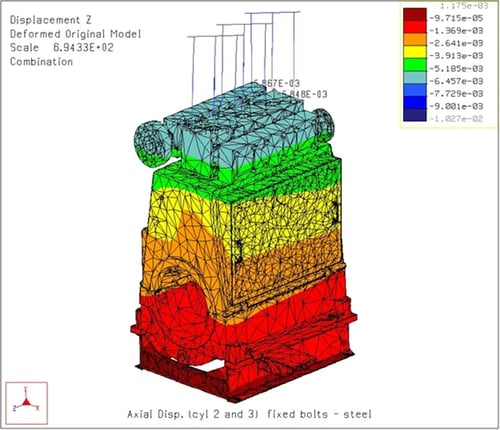
Figure 3: FEA-predicted axial displacement for the steel upper frame with bolt-hole-only restraint, showing displacement increased to approximately 11.3 mils peak-to-peak at locations A, B, C, and D. Based on this type of result and other factors it was determined that excessive vibration was related to baseplate looseness.
Were Natural Frequencies Causing the Vibration?
No. The natural frequency analysis showed that resonance at the operating speed or multiples of running speed was not the primary cause.
The pumps operated at 234 RPM (3.9 Hz). The calculated natural frequencies were much higher:
- Fully fixed baseplate: 37.7 Hz horizontal rocking mode and 51.4 Hz axial rocking mode
- Fixed at bolt holes only: 30.8 Hz horizontal rocking mode and 37.8 Hz axial rocking mode
These frequencies (Figures 4 and 5) were far above the 1x operating speed. Although one mode was closer to the 9x running-speed frequency, field data did not show that this mode was being significantly excited.
Key Takeaway
The vibration was not caused by resonance at 1x running speed or multiples of running speed. The dominant reliability issues were pressure upset conditions and baseplate looseness.

Figure 4: Example plot of a modal analysis based on the FEA results. This shows the Mode 1 natural frequency resulting in horizontal rocking motion at 37.7 Hz (well above running speed and lower values of running speed multiples) assuming the pump baseplate is fully fixed.
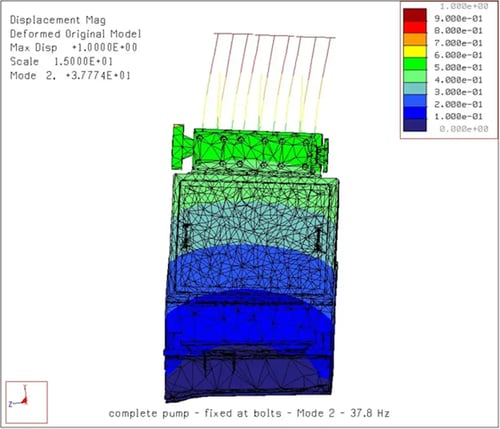
Figure 5: Another example analysis results based on different assumptions. Mode 2 natural frequency result showing axial rocking motion at 37.8 Hz when the pump was modeled assuming restraint at the baseplate bolt holes only. These “bracketing” (or sensitivity or parametric) analysis results eliminated resonance as problem the root cause.
How did FEA and Field Vibration Data Compare?
The FEA results correlated well with field measured vibration displacements at key locations (Figure 6). This correlation validated the assumptions used in the model and helped separate the effects of frame material, baseplate restraint, and operating loads.
FEA Correlation Findings
-
- Pumps A and C cast iron frame test data correlated well with a fully fixed baseplate model.
- The Pump B steel frame test data correlated better with a bolt-hole-only restraint model.
- The steel upper frame did not explain the higher vibration.
- Loose or soft mounting conditions better explained the elevated axial displacement.
Engineering Value
Using FEA with field vibration data helped the customer avoid an incorrect conclusion. The analysis showed that replacing cast iron with steel was structurally beneficial and that the higher vibration on Pump B was more likely caused by baseplate mounting looseness.
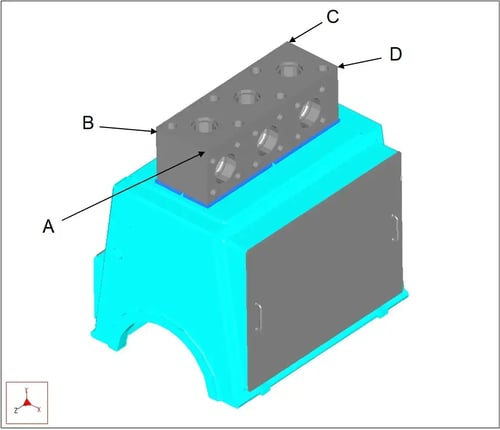 Figure 6: Vibration displacement measurement locations A, B, C, and D on the pump upper frame used to compare field vibration data with FEA-predicted pump frame displacement.
What Did the Stress Analysis Show?
The stress analysis compared cast iron and steel upper casing behavior under cylinder plunger loading. Under normal operating loads, stresses were not high enough to explain fatigue cracking. Under upset pressure conditions, however, the cast iron frame approached fatigue-risk conditions.
The Goodman diagrams showed the difference clearly:
-
- The CL25 cast iron fatigue plot indicated that a 30% pressure upset moved the stress condition into a higher-risk region.
- The A36 steel fatigue plot showed a much larger fatigue margin under the same upset condition.

Figure 7. Goodman diagram for CL25 cast iron showing that normal operating stresses remained acceptable, while an estimated 30% pressure upset moved the frame into a higher fatigue-risk condition.
 Figure 8. Goodman diagram for A36 steel quantifying the better fatigue safety margin versus CL25 cast iron under both normal and 30% higher upset pressure conditions.
Key Takeaway
Cast iron frames were vulnerable to pressure spikes, while steel frames provided a stronger fatigue margin and better long-term durability.
What Corrective Actions Were Recommended?
Mechanical Solutions recommended both mechanical improvements and monitoring upgrades.
Mechanical and Structural Recommendations
-
- Step 1:
- Confirm that the steel upper frame is installed with proper restraint and alignment
- Check and correct any baseplate grout voids
- Tighten and verify all hold-down bolts.
- Step 2 IF high vibration continues:
- Properly perform Operating Deflection Shape (ODS) and experimental modal analysis (impact) tests.
- Based on the test results, determine if the baseplate is delaminating. If so, use the calibrated FEA model to determine where to add/correct baseplate anchor bolting and/or determine if mounting surfaces need repair.
- Step 1:
Monitoring and Reliability Recommendations:
-
-
- Install pressure monitoring to detect upset events.
- Consider automatic shutdown protection for high-pressure excursions.
- Continue periodic vibration monitoring
- Trend axial and vertical displacement at consistent measurement points.
- Investigate piping system dynamics if vibration persists.
-
What Were the Final Conclusions?
The investigation produced four major conclusions:
- Normal operating loads did not explain the cast iron frame cracking.
- Pressure upset conditions were the most likely cause of cracking in the cast iron upper frames.
- The Pump B steel replacement frame provided a stronger fatigue margin and was not the source of excessive vibration.
- Pump B’s excessive axial vibration was most consistent with baseplate looseness or soft mounting, not structural resonance.
Reciprocating pump vibration and frame cracking can be reduced by combining FEA, field vibration testing, fatigue analysis, and baseplate inspection. In this case history, FEA showed that cast iron frame cracking was likely caused by pressure upset conditions, while excessive vibration on one pump was linked to loose baseplate mounting rather than resonance or steel frame replacement.
Frequently Asked Questions
What causes reciprocating pump vibration?
Reciprocating pump vibration is commonly caused by plunger forces, pressure pulsations, foundation looseness, baseplate flexibility, resonance, misalignment, or piping interaction. In this case, excessive axial vibration was most consistent with loose or soft baseplate mounting.
Why do reciprocating pump frames crack?
Reciprocating pump frames crack when cyclic stresses exceed the fatigue capability of the frame material. In this case, normal operating loads did not explain the cracking, but pressure upset conditions could increase stress enough to create fatigue risk in cast iron frames.
Are steel pump frames better than cast iron pump frames?
Steel pump frames can provide better fatigue resistance, lower deflection, and a larger safety margin during pressure upset conditions. In this case, the steel frame was structurally superior to the cast iron frame and was not the cause of excessive vibration.
How can excessive reciprocating pump vibration be reduced?
Excessive reciprocating pump vibration can be reduced by ensuring hold-down bolt torque meets specified requirements, improving baseplate anchoring, re-grouting loose foundations, monitoring pressure pulsations, checking piping dynamics, and using FEA to validate structural behavior.
Can FEA identify the root cause of pump vibration?
Yes. FEA can identify whether vibration is related to structural flexibility, natural frequency, operating loads, or mounting conditions. When correlated with field vibration data, FEA can distinguish between resonance, looseness, and material-related issues.
Was resonance causing the pump vibration?
No. The pump operated at 3.9 Hz, while the calculated lower order natural frequencies were between 30.8 Hz and 51.4 Hz. This showed that resonance at the 1x operating speed or multiples of running speed was not the cause.
What is a Goodman diagram used for in pump failure analysis?
A Goodman diagram is used to evaluate fatigue risk by comparing steady stress and alternating stress against a material’s fatigue limit. In this case, Goodman diagrams showed that cast iron had lower fatigue margin than A36 steel under pressure upset conditions.