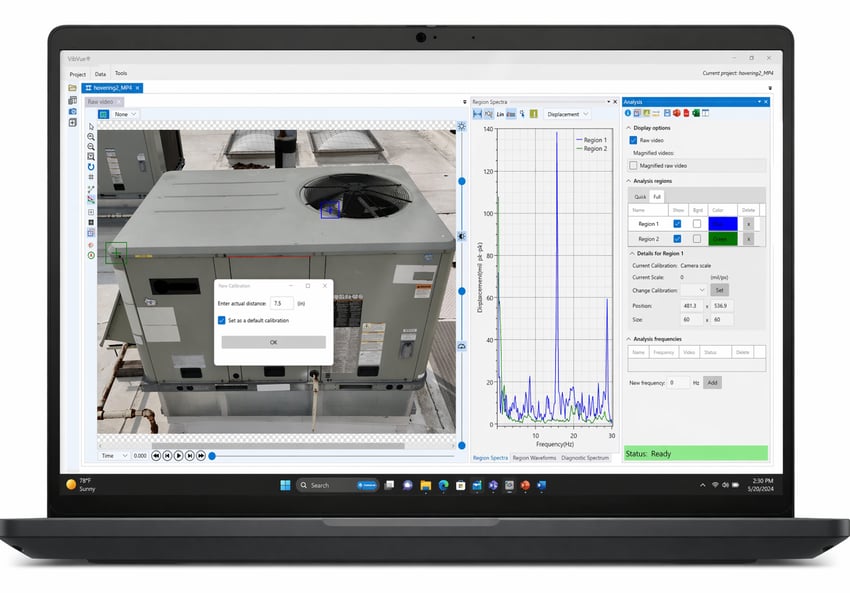
Turn Any Video into Vibration Data
Video-based vibration analysis has been limited by hardware restrictions and complex calibration workflows. VibVue® 4.1.2.3 removes those barriers allowing you to analyze any video, from almost any camera.
This release is built around a simple premise — the video you already have should be good enough to analyze.* Two headline features make that real.
Import MP4 and MOV from any camera
You no longer need a VibVue®-native video or project to run an analysis. Drop in footage from any source — a smartphone, a drone, a plant-floor security camera, a contractor's GoPro. If it's MP4 or MOV, VibVue® can import it.
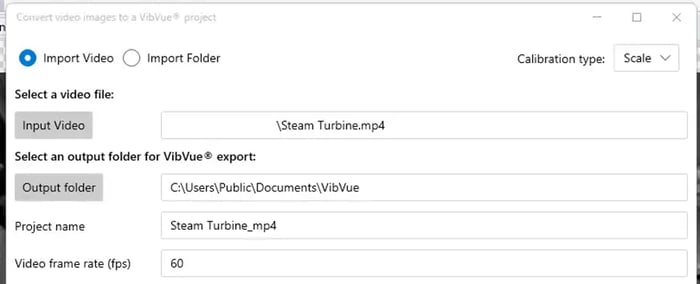
Figure 1. The new import dialog — select any MP4 or MOV, set a project name and create.
What this unlocks:
- Faster root-cause response. Field techs can capture running equipment on whatever camera they have access to, then hand off the footage to a reliability engineer for full vibration analysis back at the desk.
- Retroactive investigation. Incident footage from before you owned VibVue® is now analyzable. Historical video libraries become diagnostic assets.
- Drone and remote deployments. Elevated motors, stacks, cooling towers, offshore assets — land the drone and record (hovering stabilization coming in a future update), then analyze in VibVue®. No more camera rigging at altitude.
- Lower barrier to evaluation. Teams piloting VibVue® can test it against their own existing setup before committing to dedicated capture hardware.
For teams worried about being locked into single-vendor camera ecosystems, this is the end of that constraint.
Measurement line calibration — no camera parameters required
The second shift is equally significant. Traditional workflows requires detailed camera parameters like pixel pitch, focal length of lens, and distance to target. Any errors in these inputs can reduce accuracy.
VibVue® eliminates that requirement entirely.
VibVue® 4.1.2.3 introduces measurement line calibration. Draw a line across any object of known dimension in the scene — a coupling guard, a bolt pattern, a ruler, or a machine-vision calibration sticker taped to the target — enter the real-world length, and done. VibVue® scales pixel displacement to reference objects directly within the scene itself.
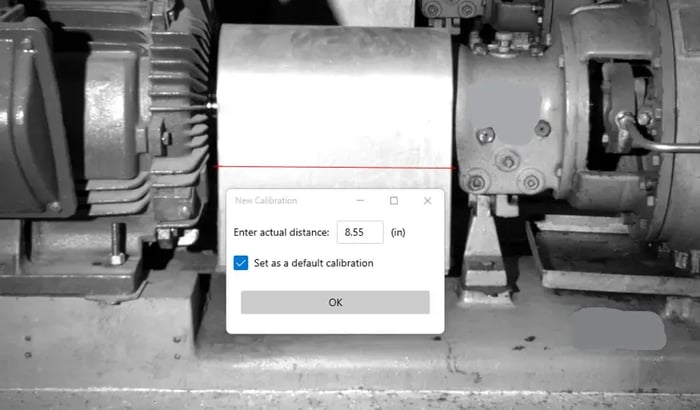
Figure 2. Measurement line drawn across a coupling guard of known dimension — calibration completed in two clicks and an entered value.
Pair that with the new region-specific calibration with custom scaling, and you can define localized reference zones for complex scenes where a single global scale isn't adequate for precision accuracy.
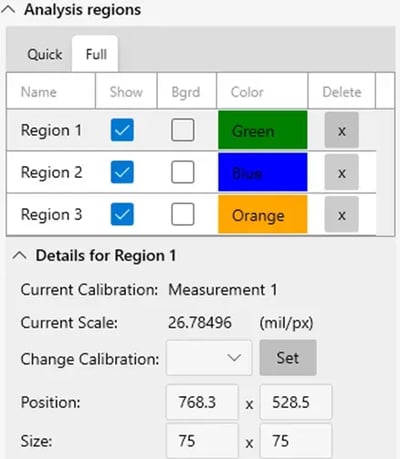
Figure 3. Region-specific calibration lets each analysis region carry its own scale factor.
The practical consequence: a video someone else shot, on a camera you've never touched, is now fully analyzable — quantitatively and qualitatively.
The bigger picture
4.1.2.3 is an accessibility and flexibility release. It decouples VibVue®'s analytical power from any specific capture device and removes the calibration friction that has kept video-based vibration analysis a specialist workflow. If you've been waiting for video-based vibration analysis to meet your equipment where it is — this is the version.
*Applies to base-level vibration analysis features in VibVue® Lite. For maximum performance — higher vibration detection thresholds and VibVue® Pro-exclusive capabilities like the Warp Speed high-frequency engine — VibVue® Standard cameras are still recommended.
Current customers: Renew your service plan to upgrade to VibVue® 4.1.2.3 and gain access to ongoing releases plus complimentary expert consultations on your VibVue® project data from MSI engineers.
Evaluating VibVue®? Send us your footage, and we will show you exactly what VibVue® can uncover.
General inquiries: info@mechsol.com
VibVue® / TrakVue® inquiries: peter.lazzaro@mechsol.com to request a demo