Hydropower CFD Analysis, Forensic Engineering, and Expert Witness Support
Executive Summary
During start-up testing of large Francis hydro turbine generators, excessive vibration occurred at low-load operation. Mechanical Solutions, Inc. (MSI) performed an independent forensic engineering investigation using high-fidelity Unsteady CFD (Computational Fluid Dynamics) hydropower modeling and turbine vibration analysis. MSI identified a hydraulic design deficiency causing asynchronous vibration and developed a low-cost air injection solution. MSI later served as expert witness engineering support in litigation, resulting in funded remediation and reliable renewable energy integration.
Overview
During start-up trials of multiple large hydro turbine generators, Mechanical Solutions, Inc. was retained by a hydroelectric power company to provide independent forensic engineering and expert witness engineering support in a contractual dispute with a major turbine manufacturer. The Francis turbines experienced hydro turbine vibration exceeding allowable limits when operating in the lower approved region of the power vs. flow Hill Chart.
Industry
- Hydroelectric Power Generation
- Utility-Scale Francis Turbine-Generator Systems
Challenge
All units exhibited vibration levels exceeding contractual and industry limits at low-load operation. The central contractual question was whether the vibration behavior violated technical specifications and ISO 20816-5 hydro turbine vibration standards, for which MSI contributed as an author.
Key challenges included:
- Verification of damaging hydro turbine vibration levels
- Identification of mechanical versus hydraulic excitation sources
- Determination of design responsibility
- Development of a mitigation strategy without extended outages
Engineering Approach
MSI performed a comprehensive hydropower forensic engineering investigation, including:
- Review of acceptance test data and operating history
- Comparison of measured vibration levels to ISO 20816-5 limits
- Rotor dynamics analysis and critical speed evaluation
- Separation of synchronous (1× rpm) and asynchronous vibration components
- Advanced Unsteady CFD hydropower analysis of the complete turbine flow path
This structured approach ensured results suitable for for technical validation, mediation, and court testimony.
Findings
Mechanical Dynamics
Rotor dynamic analysis showed the second critical speed to be well damped but too close to operating speed, producing elevated 1× rpm vibration. While this contributed to vibration levels, it was determined to be a minor factor relative to applicable hydro turbine vibration standards. A mechanical modification was designed but not recommended due to cost and limited benefit.
Hydraulic Root Cause
The dominant vibration was asynchronous, occurring outside integer running speed harmonics—indicating a fluid dynamic instability rather than mechanical imbalance.
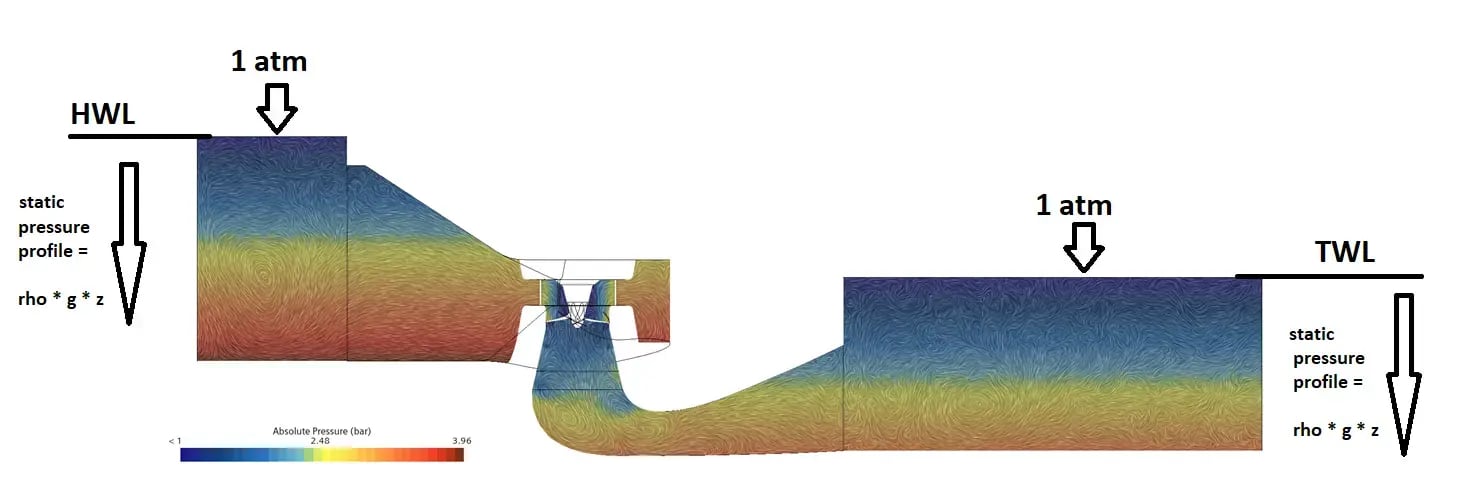
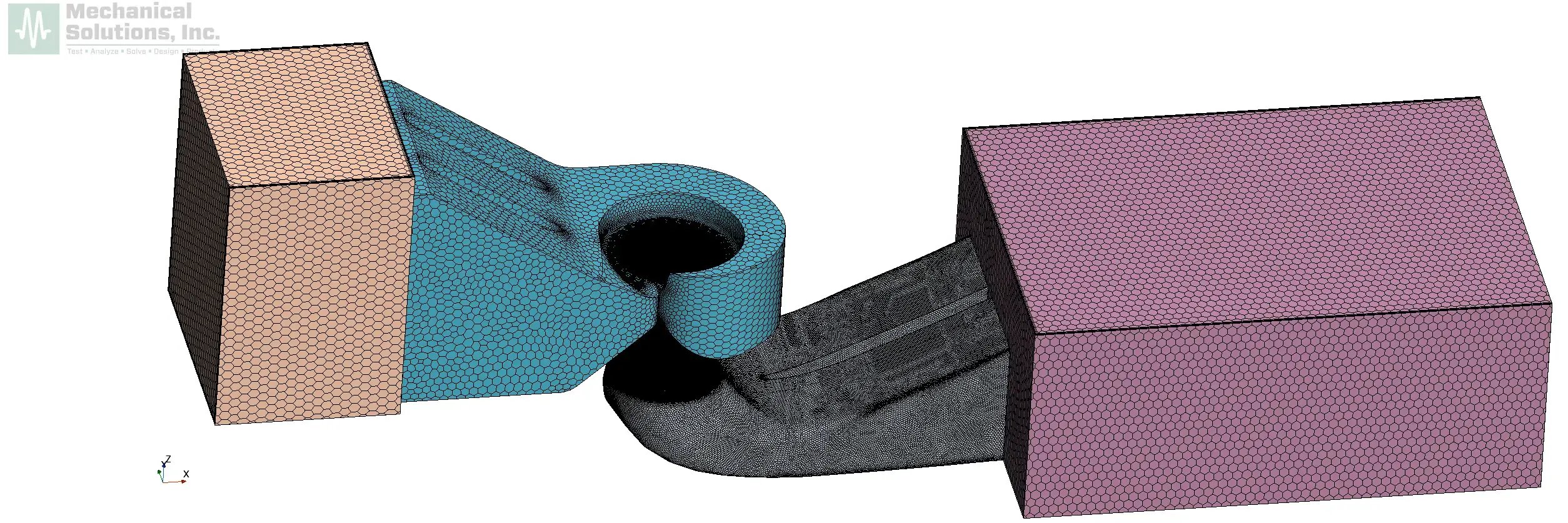
MSI conducted a high-resolution Unsteady CFD hydropower simulation, modeling:
- Headwater and dam intake
- Turbine inlet and wicket gates
- Runner with rotating blade passages
- Draft tube and splitter
- Tailwater and downstream river
The Unsteady (transient), two-phase CFD model included cavitation effects, 125 million mesh volumes, and microsecond-scale time steps to capture transient flow physics.
Figure 1: Cross-section (top) and 3-D meshed perspective view of the hydroturbine system Unsteady CFD model
CFD Results
The Unsteady CFD hydropower analysis revealed:
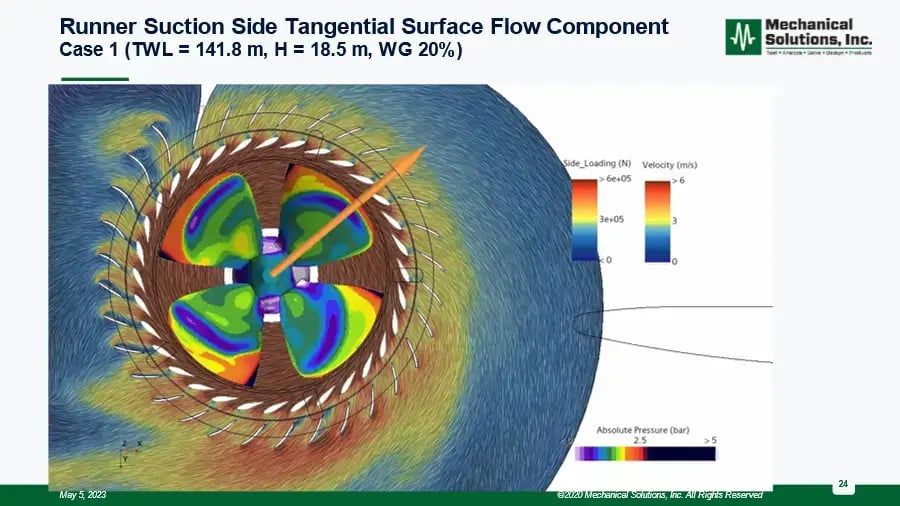
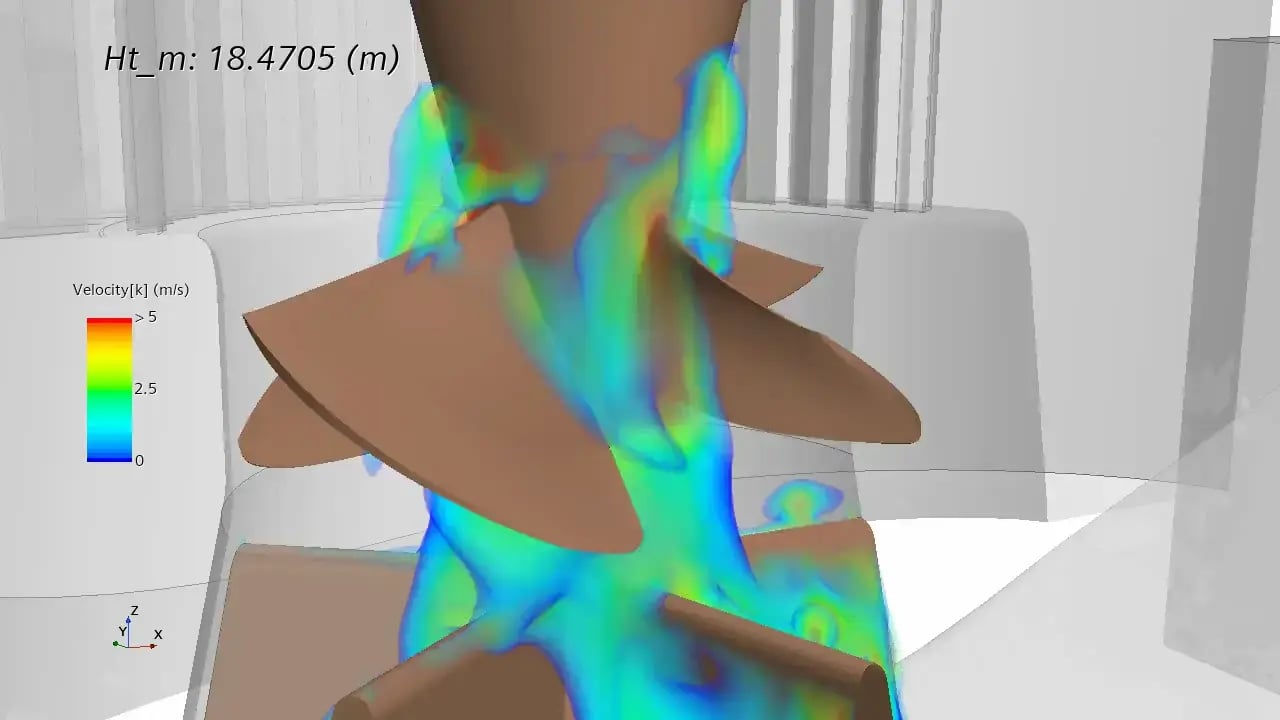
- Unexpected reverse (upward) flow recirculation through the runner at low power
- Tangential velocity fields generating rotating radial forces
- Asynchronous forcing frequencies matching plant vibration measurements
Critically, the Unsteady CFD demonstrated the issue was a turbine design deficiency, not an operational or installation problem. The model also enabled quantitative evaluation of remediation options, supporting mediation and litigation.
Solution
MSI recommended air injection at the runner hub as a corrective action. Unsteady CFD results showed that approximately 1% air injection:
- Disrupted recirculating flow structures
- Eliminated asynchronous hydraulic forcing
- Reduced hydro turbine vibration to acceptable levels
The solution avoided major disassembly and minimized outage duration.
Figure 2: Results from Unsteady CFD analysis of the hydroturbine flow path at low power conditions. The colored zones in the left picture represent upward recirculating flow. The arrow in the right picture is net force.
|
|
|
Outcome
- Excessive hydro turbine vibration eliminated at low-load operation
- Contractual responsibility technically established
- MSI provided expert witness engineering testimony in court
- Remediation costs funded through litigation outcome
- Reliable renewable hydropower capacity added to the North American grid
Key Capabilities Demonstrated
- Hydro turbine vibration analysis
- Unsteady CFD hydropower modeling and cavitation simulation
- Rotor dynamics and critical speed evaluation
- Forensic engineering for contract disputes
- Expert witness engineering and litigation support
FAQ
What causes hydro turbine vibration at low load?
Hydro turbine vibration at low load is often caused by hydraulic instabilities such as flow recirculation, cavitation, or asynchronous forcing. In this case, Unsteady CFD hydropower analysis revealed reverse flow through the runner that generated rotating hydraulic forces.
How is Unsteady CFD used in hydropower vibration analysis?
CFD hydropower analysis models unsteady flow through the turbine, including wicket gates, runner passages, draft tube, and tailwater. It allows engineers to identify hydraulic instabilities, cavitation, and forcing mechanisms that cannot be detected through vibration data alone.
What is asynchronous vibration in hydro turbines?
Asynchronous vibration occurs at frequencies not tied to running speed or its harmonics. It typically indicates hydraulic excitation rather than mechanical imbalance and is often associated with flow instabilities at partial load operation.
What standards apply to hydro turbine vibration?
Hydro turbine vibration is commonly evaluated using ISO 20816-5, which defines acceptable vibration limits and measurement practices for hydraulic turbine-generator units.
Can hydro turbine vibration be fixed without major outages?
Yes. In this case, Unsteady CFD analysis showed that a small amount of runner hub air injection eliminated recirculating flow and reduced vibration, avoiding costly disassembly or extended outages.
What role does expert witness engineering play in turbine disputes?
Expert witness engineering provides independent, technically defensible analysis to determine root cause, standards compliance, and contractual responsibility. This includes forensic vibration analysis, Unsteady CFD modeling, and court testimony.
How does Unsteady CFD help determine design responsibility?
Unsteady CFD can demonstrate whether vibration originates from inherent hydraulic design behavior rather than installation or operation. When validated against plant data, it provides strong evidence of design deficiencies in legal and contractual disputes.