
Solving High Vibration in a Boiler Feed Pump with VibVue® Motion Magnification and Modal Testing
Summary
A power plant's 10,000 HP steam turbine-driven boiler feed pump (BFP) was running with overall vibration levels of 1.0 to 2.0 in/s peak. Mechanical Solutions (MSI) used VibVue® motion magnification (Figures 1 and 2), continuous monitoring (Figure 3), Time Averaged Pulse TAP™ Experimental Modal Analysis (impact), and Operating Deflection Shape (ODS) testing methods to find the root cause: an outboard bearing housing (OBB) rocking mode near 500 Hz in resonance with the pump's Vane Pass Frequency (VPF). MSI recommended properly mounting a 100 pounds of mass to the OBB to detune the mode. Vibration dropped more than tenfold, from 1.30 to 0.10 in/s peak, without the solution introducing new vibration issues.
What Symptoms Pointed to Resonance?
- OBB vibration readings of 1.0 to 2.0 in/s peak (portable data collector, by others)
- Highest level on the OBB at the lower end of the rpm range: 1.32 in/s RMS at 4,410 RPM
- Vibration dominated by a discrete vane pass frequency near 500 Hz, not 1x running speed
- Vibration dropping to 0.40 in/s RMS at high speed, a classic sign of an excited natural frequency (resonance)
- Duty: power generation BFP, we believe the plant is now cycling as a peaking unit that runs more often at lower rpm.
Figure 1: VibVue® motion magnification at the 1x running speed frequency (73 Hz) shows negligible pump motion. The VibVue® FFT spectra showed normal 1x amplitudes, and the foundation and nearby piping moved only at normal levels.
Figure 2: Motion magnification at the 511 Hz vane pass frequency (VPF) shows large outboard bearing housing (OBB) motion at the low end of the speed range, an early sign of resonance.
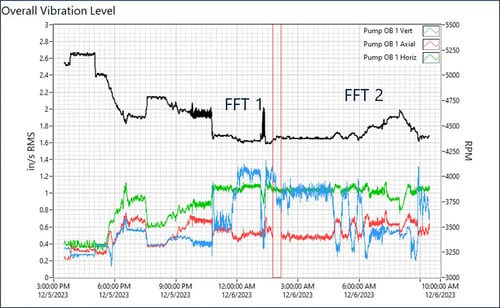
Figure 3: Continuous monitoring over 19 hours compares OBB vibration in three directions against pump speed. Vibration peaked at 1.32 in/s RMS at low speed and fell to 0.40 in/s RMS at high speed.
How Did MSI Find the Root Cause Without a Teardown?
Four Field Test Methods, One Consistent Answer
- VibVue® motion magnification: negligible motion at 1x running speed (73 Hz), large OBB motion at the 511 Hz vane pass frequency.
- Continuous monitoring: triaxial accelerometers logged 19 hours across the speed range.
- TAP™ impact testing during operation: Experimental Modal Analysis (EMA) with the pump running, capturing real bearing stiffness, damping and the Lomakin effect. Modes near 1x were not excited, but an OBB rocking mode sat at approximately 500 Hz, inside the VPF range (Figture 4).
- ODS testing: data from more than 250 points, animated on a CAD model, showed the OBB rocking at vane pass (Figures 5 to 7).
All four tests pointed to the same mode, matching MSI's experience with similar larger BB5 pumps.
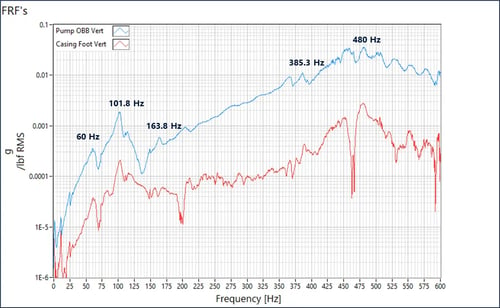
Figure 4: Frequency Response Function (FRF) from TAP™ impact testing with the pump running shows how the rotor-bearing system responds to a measured hammer input. Natural frequencies from below running speed up to the first VPF were not at risk.
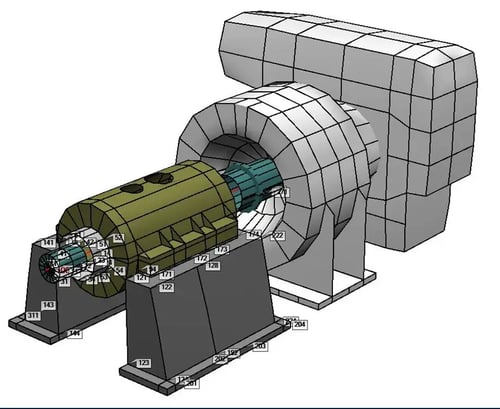
Figure 5: Model used to animate ODS test data. Triaxial accelerometer data was recorded at more than 250 locations and mapped to the CAD model that MSI built from field measurements and drawings.
Figure 6: ODS animation at the 513 Hz vane pass frequency (front view) shows excessive OBB motion, confirming the VibVue® result in Figure 2. ODS animations are measured field data in motion, not an FEA simulation.
Figure 7: Side view of the 492 Hz OBB rocking mode. Adding about 100 pounds of properly secured mass to the OBB detuned the mode and cut vibration more than tenfold, from 1.30 to 0.10 in/s peak, without introducing new issues.
What Caused the Boiler Feed Pump Vibration?
OBB Rocking Mode Resonant with Vane Pass Frequency
Resonance. The 492 Hz OBB rocking mode was excited by vane pass frequency (7 times running speed). At the low end of the speed range, vane pass landed on the natural frequency and normal hydraulic forces became excessive vibration. Peaking duty made low-speed running, and the problem, more frequent.
How Was the Resonance Fixed?
Mass Addition Sized from Test Data
MSI recommended lowering the OBB natural frequency to at least 10% below the minimum vane pass frequency by securing about 100 pounds of mass to the OBB, and checked that the mass would not push another natural frequency into resonance.
Result: OBB vibration fell from 1.30 to 0.10 in/s peak, more than tenfold, with no new issues. Resonance can amplify vibration ten times or more, so removing it typically brings a drop this large.
Why Do BB5 Boiler Feed Pumps Resonate at Vane Pass?
Large diffuser-style BB5 boiler feed pumps often have OBB natural frequencies near vane pass, so they can resonate even with normal excitation and an acceptable Gap B (Figure 8). Adding mass is a proven "old school" fix. What is new is precision: MSI sized the mass from test data in one step instead of trial-and-error guesses, and confirmed it would not create a new problem.
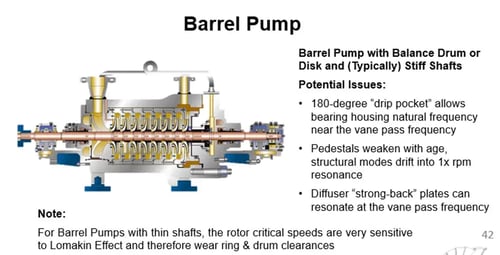
Figure 8: From MSI's annual one-day short course, Vibration Problems and Solutions in Pumps and Turbomachinery, at the Texas A&M Turbomachinery & Pump Symposia: a top-level summary of typical vibration problems for different types of rotating machines and models, regardless of manufacturer.
Frequently Asked Questions
What is vane pass frequency in a pump?
Vane pass frequency (VPF) is the number of impeller vanes multiplied by running speed. This pump's 7-vane impeller produces about 500 to 610 Hz across its speed range. It becomes a problem when it lines up with a lightly damped natural frequency.
What causes high vibration in a boiler feed pump?
Common causes are resonance, unbalance, misalignment, worn clearances, cavitation or recirculation, and foundation problems. Here, the outboard bearing housing was resonating at vane pass frequency.
How can you tell if pump vibration is caused by resonance?
Look for vibration that changes sharply with speed and is dominated by one discrete frequency. Impact testing confirms it by finding a natural frequency within about 10% of the excitation. This blog describes a relatively easy method to determine an issue may be resonance.
Why perform Experimental Modal Analysis (impact) testing while the pump is running?
Running conditions change bearing stiffness, damping and the Lomakin effect, so a stopped-pump test can misplace natural frequencies. MSI's TAP™ method measures them with the pump running. More info.
How does motion magnification help diagnose vibration?
VibVue® motion magnification turns ordinary video into a view of tiny vibration, frequency by frequency, across the machine, foundation and piping at once. It is fast and non-contact, so it shows where to focus more detailed testing. In some cases, a problem can be successfully diagnosed just with VibVue®.
Can adding mass fix a resonance problem?
Yes. Adding mass lowers a natural frequency away from the excitation, if it is sized from test data and checked against new resonances. Here, a 100 pounds cut vibration more than tenfold. Other less optimal fix options were to change the impeller vane count, lock out the lower running speeds, or improve stiffness at the bearing housing to casing connection. Adding mass was the most practical.
How much separation margin is needed to avoid resonance?
Industry guidance commonly targets at least 10% between a natural frequency and any excitation in the operating range based on a properly performed impact test, the target MSI used here. 15% is recommended for Finite Element Analysis (FEA) assuming an experienced analyst who makes sensible assumptions. More info at ANSI/Hydraulic Institute 9.6.8 entitled Rotodynamic Pumps – Guidelines for Dynamics of Pump Machinery.