Solving a Reciprocating Compressor Pressure Pulsation Induced Resonance Problem
MSI has a long history of working with reciprocating machinery. This case history is based on a project from 2003, so some of the figures may appear dated.
Like many troubleshooting projects, this issue could have been resolved more quickly and efficiently if MSI's motion magnification video technology, VibVue®, had been available in 2003.
Summary
An acoustic resonance was the suspected root cause for excessive piping vibration in a high-value CO2 application. Fortunately, specialized testing by MSI efficiently identified that high discharge pressure pulsations interacting with a discharge pipe structural natural frequency (i.e., resonance) was the primary problem root cause. Most importantly, MSI was able to recommend a practical fix to the potentially dangerous problem.
-
- Dominant vibration frequencies at 6 Hz, 12 Hz, and 30 Hz
- Pressure pulsations (up to 12 psi peak-to-peak) driving resonance (Figure 1)
- A discharge piping natural frequency near 6Hz (Figure 2) and structural looseness amplifying vibration (Figure 3)
- Flowmeter calibration issues directly linked to pipe vibration at 12 Hz
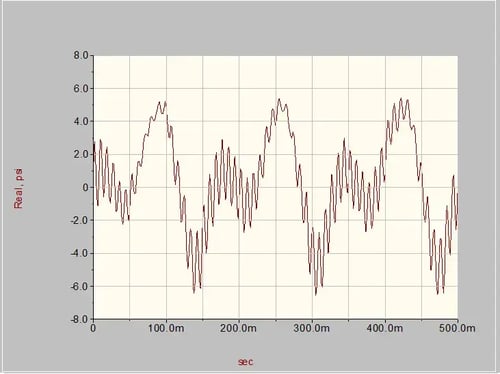
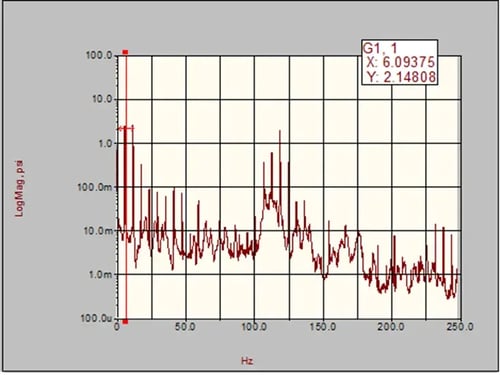 Figure 1: Top - Cylinder 1 discharge pressure fluctuations measured using dynamic pressure transducers was 12 psi peak to peak oscillation. Bottom - most of it at a 6 Hz frequency (1 times running speed) and 12 Hz.
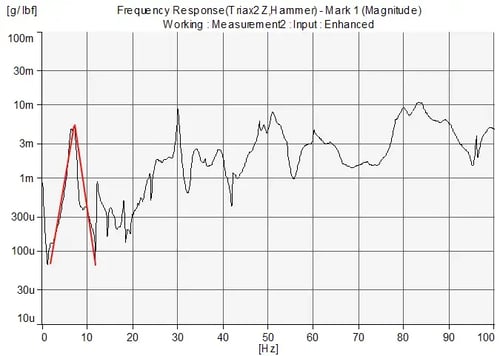
Figure 2: Discharge pipe elbow Frequency Response Function (FRF) plot of the Experimental Modal Analysis (or impact) test MSI performed while the compressor was operating. The peak near at 6 Hz indicates a structural natural frequency which was also confirmed with Operating Deflection Shape (ODS) testing.
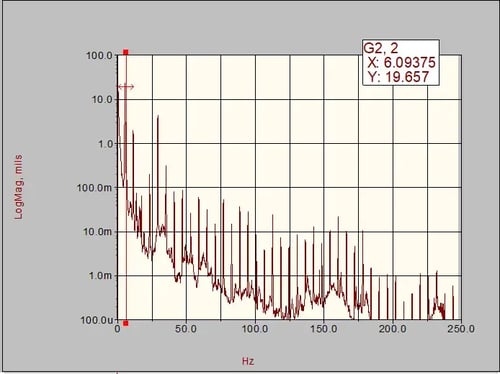
Figure 3: Discharge pipe elbow vibration was excessive due to a structural vibration response (over 10 mils) to the high 12 psi Cylinder 1 pressure pulsation at 6 Hz. This data is plotted logarithmically so that resonance peaks are evident in the spectrum “noise floor.” The broadband peaks near 6 Hz and 30 Hz further confirm the Figure 2 experimental modal analysis (i.e., impact) test results – that the large pipe motion is due to structural pipe resonance.
Recommended Solution:
Install targeted discharge piping supports at MSI specified locations to detune resonance, and optionally increase discharge bottle size to reduce pulsation amplitude.
What Causes Excessive Reciprocating Compressors Vibration?
Excessive vibration in reciprocating compressors is commonly caused by:
-
Pressure pulsations with high harmonic content
-
Structural resonance in piping systems
-
Insufficient or degraded piping supports
-
Mechanical looseness in compressor components
In this case, high discharge pulsations exciting a discharge pipe elbow structural resonance frequency was the primary driver—not acoustic amplification.
How Was the Vibration Testing Performed?
Testing Methods Used
-
Operational vibration measurements across:
-
Cylinders
-
Baseplate and foundation
-
Piping systems
-
Flowmeter
-
-
Experimental Modal Analysis (or impact) testing while the compressor operated to identify natural frequencies
-
Dynamic pressure measurements using high-frequency transducers
-
Operating Deflection Shape (ODS) testing for visualizing vibration modes
Why ODS Analysis Matters
ODS analysis allows engineers to:
-
- Visualize real-time vibration behavior
- Identify resonance locations
- Pinpoint structural weaknesses
What Were the Key Vibration Frequencies Identified?
Primary Frequencies
- 6 Hz (Running Speed)
- Caused significant piping resonance
- 12 Hz
- Responsible for flowmeter vibration and calibration drift
- 30 Hz
- Linked to structural looseness (Cylinder 2 support)
- Amplified by minor acoustic effects
Why Did the Flowmeter Lose Calibration?
The flowmeter experienced calibration drift due to:
- Pipe vibration (~1 mil peak-to-peak)
- Excitation at 12 Hz frequency
- Transmission of vibration from upstream piping
Key Insight
Remember that Flowmeter calibration issues in reciprocating compressor systems can be caused by mechanically induced vibration rather than instrumentation faults.
Was Acoustic Resonance a Significant Factor?
No—acoustic resonance played a minor role.
- Slight amplification:
- ~1x at 6 Hz
- Up to ~3x at 30 Hz
- However, structural resonance driven by pulsations was the dominant mechanism
What Is the Root Cause of the Vibration Problem?
Primary Root Cause
A combination of:
-
High discharge pressure pulsations
-
Structural resonance at natural frequencies
Secondary Contributors
-
Loose cylinder support
-
Inadequate piping support
-
System stiffness changes after refurbishment
How Can Reciprocating Compressor Vibration Be Reduced?
Recommended Solutions
1. Improve Structural Support
-
Reinforce existing supports
-
Add supports at high-motion
-
Focus on 6 Hz, 12 Hz, and 30 Hz response
2. Detune Resonance
-
Shift natural frequencies away from excitation frequencies
-
Add supports incrementally and monitor response
3. Address Mechanical Looseness
-
Inspect and tighten:
-
Cylinder 2 vertical support
-
Piping connections
-
4. Consider Larger Discharge Bottles
-
-
Reduce pressure pulsations
-
Improve long-term system stability
-
5. If a resonance issue is suspected use a combination of the specialized test methods discussed above to identify the problem root cause and Finite Element Analysis (FEA) methods to design and “test” the solution to avoid trial and error problem solving.
Frequently Asked Questions
What is the main cause of piping vibration in reciprocating compressors?
The main cause in this case is pressure pulsations interacting with structural natural frequencies, not acoustic resonance.
What frequencies are most critical in compressor vibration?
Typically running speed harmonics, such as 6 Hz, 12 Hz, and 30 Hz in this case.
How do you fix resonance in piping systems?
By adding supports to shift natural frequencies (detuning) and reducing excitation forces.
Can vibration affect flowmeter accuracy?
Yes. Even moderate vibration (~1 mil) can cause calibration drift and measurement errors.
Are larger discharge bottles necessary?
Not always, but they help reduce pulsation amplitude and improve long-term reliability.