Cavitation Surge and Acoustic Resonance
Summary
A nuclear power plant experienced severe sub-synchronous vibration in its Residual Heat Removal (RHR) pumps under low-flow operating conditions. MSI conducted advanced acoustic and fluid-structure interaction (FSI) analyses identified cavitation surge exciting an acoustic resonance at the discharge piping at 11.5 Hz, significantly amplifying the magnitude of pressure pulsations and vibration. An interim mitigation solution using a twin Helmholtz resonator system was engineered and successfully implemented to control the vibration and protect pump integrity.
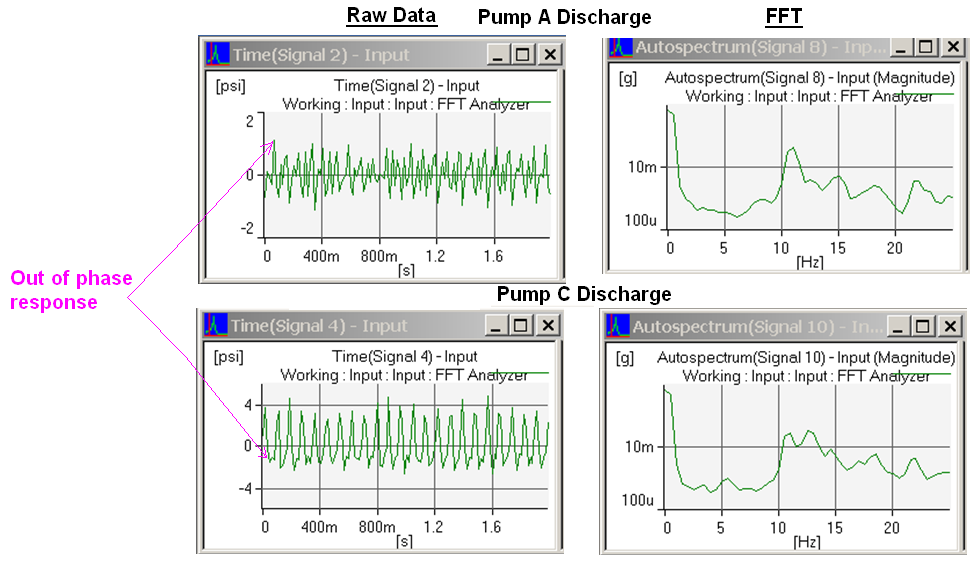
Figure 1. Example Pumps A and C discharge pressure dynamic data and FFT plots showing the 11.5 Hertz acoustic natural frequency at the pump discharge being excited by cavitation surge at lower flow rates.
What Caused Excessive Sub-Synchronous Vibration in the RHR Pumps?
A nuclear power plant reported chronic excessive sub-synchronous vibration affecting the Residual Heat Removal (RHR) pumps A and C. The vibration became most severe when Pump C operated at low flow, while Pump A was in idle.
Under these conditions:
-
Both pumps exhibited high vibration levels
-
The non-operating Pump A experienced higher vibration than the operating Pump C
-
Vibration amplitudes exceeded acceptable limits for long-term pump reliability
This behavior indicated a system-level hydraulic and acoustic vibration phenomena, rather than a localized mechanical fault.
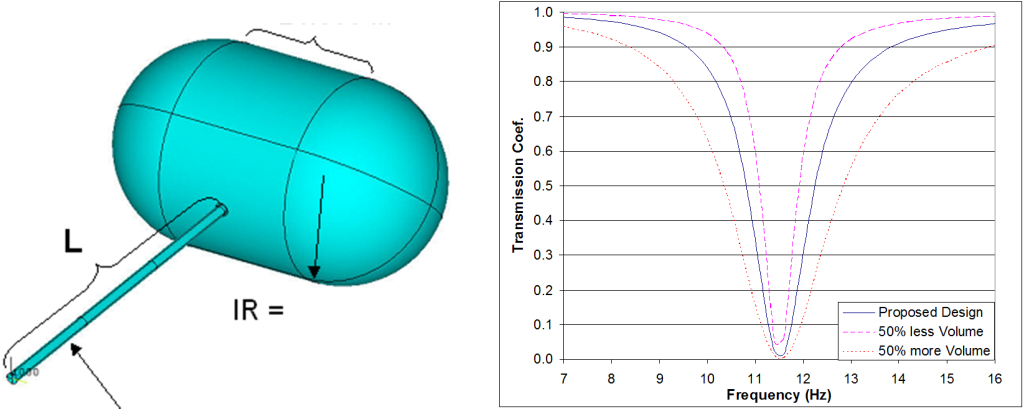
Figure 2. Left - Example Helmholtz regulator. Right - The effective frequency bandwidth for the Helmholtz resonator changes as a function of tank volume and can be traded to meet frequency range requirements versus physical space constraints.
How Was Cavitation Surge Identified as the Root Cause?
Previously conducted specialized hydraulic and acoustic testing confirmed the root cause as cavitation surge, a form of hydraulic instability characterized by low-frequency oscillating cavitation (auto-oscillation).
Cavitation surge alone poses a significant threat to:
- Pump internals
- Bearings and seals
- Long-term equipment reliability
In this case, the issue was compounded by a coincident acoustic piping resonance.
Why Did Acoustic Resonance Amplify the Vibration Problem?
The cavitation surge pressure pulsations excited an acoustic discharge piping mode at 11.5 Hz, causing dramatic amplification of vibration levels throughout the pump and piping system.
While acoustic piping modes are more commonly excited by super-synchronous vibration, such as vane pass frequencies, low-frequency excitation from cavitation surge can be equally destructive when resonance conditions exist.
This coupling of hydraulic instability and acoustic resonance significantly increased system response and risk.
What Solution Options Were Evaluated?
Two primary mitigation strategies were considered:
1. Addressing the Excitation Source
-
Impeller redesign to eliminate cavitation surge
-
Considered the preferred permanent solution
2. Attenuating the Acoustic / Structural Response
-
Modifying the piping system’s acoustic behavior
-
Required as an interim solution until impeller redesign could be implemented
How Did the Helmholtz Resonator Solve the Acoustic Resonance Issue?
As part of a detailed pump and piping system acoustic analysis, a twin Helmholtz resonator system was designed using fluid-structure interaction (FSI) finite element analysis (FEA).
The resonator system was specifically tuned to:
- Absorb acoustic pressure pulsations near 11.5 Hz
- Shift the piping system’s acoustic natural frequency away from the main excitation source
- Avoid major piping modifications
What Is a Helmholtz Resonator?
A Helmholtz resonator consists of:
- An acoustic cavity
- A restricted neck connected to the piping system
The system behaves like a single-degree-of-freedom mass–spring oscillator, where:
- The fluid in the neck acts as the oscillating mass
- The compressibility (bulk modulus) of the cavity fluid acts as the spring
Helmholtz resonators are commonly used to mitigate ¼-wave and ½-wave piping resonance, making them well-suited for this application.
Why Was a Twin Helmholtz Resonator Selected?
A twin resonator configuration provided:
- Broader frequency attenuation around the target resonance
- Increased robustness across varying pump operating conditions
- Improved performance without increasing leakage risk
Alternative solutions such as high-pass filter tube arrays and membrane pulsation dampers were evaluated but deemed higher risk due to potential leakage concerns, particularly in nuclear service.
How Did FSI and Forced Response Analysis Support the Final Design?
Advanced FSI FEA and forced response analyses were used to:
- Evaluate the impact of reduced-stiffness flex hoses in the resonator neck
- Sizing the resonator neck, lengths ,and cavity volumes to achieve the target absorber frequency
- Account for installation constraints and spatial limitations
- Analyze multiple combinations of pump operating conditions and valve positions
What Were the Final Deliverables?
The engineering effort resulted in:
- Detailed Helmholtz resonator design drawings
- Installation instructions supported by analytical results
- Verified mitigation performance across all anticipated operating conditions
The interim solution successfully reduced acoustic pressure pulsations and vibration levels, allowing safe operation until the permanent impeller redesign could be implemented.
Frequently Asked Questions
What is cavitation surge in pumps?
Cavitation surge is a low-frequency oscillating form of cavitation that occurs under unstable hydraulic conditions, often at low flow rates, and can cause severe vibration and pressure pulsations.
Why is sub-synchronous vibration a concern in nuclear pumps?
Sub-synchronous vibration can indicate hydraulic instability or system resonance, leading to accelerated wear, seal damage, bearing failure, and reduced equipment reliability.
How does acoustic resonance affect piping systems?
Acoustic resonance amplifies pressure pulsations when excitation frequencies align with piping acoustic natural frequencies, significantly increasing vibration response.
Why use a Helmholtz resonator instead of piping modifications?
Helmholtz resonators can shift acoustic frequencies and absorb pulsations without extensive piping rework, reducing cost, outage time, and installation risk.
Is this approach applicable outside nuclear power plants?
Yes. Helmholtz resonators and acoustic analysis techniques are widely applicable to refinery pumping systems, chemical process systems, and other high-energy piping networks.